|
Virtual reality simulator
for robotic surgery. Validation study. |
||||
|
Vadim V. DALININ, MD1 , Fredrik H. HALVORSEN, MD2,
, Ole Jakob ELLE, MSc, PhD2, Jan Sigurd RØTNES, MD,PhD2,3, Erik FOSSE,
MD, PhD2 |
||||
|
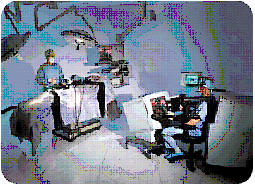
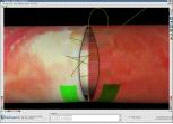
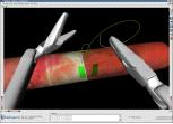
Abstract Introduction: Robotically assisted endoscopic procedures are associated with a definite learning curve. The standard way of gaining the necessary surgical technical skills has until recently been training in dry lab followed by animal experiences. VR-simulators surgical training was proposed few years ago and this form of training holds the potential of reducing the more expensive and ethical questionable use of animals in surgical training without compromising surgical outcome in the OR. Also VR-trainng could seriously decrease the cost of robotic related training procedures. The aim of the study was to determine if training robotically assisted suturing skills on the VR-simulator equals similar training in the dry lab. Material and methods: Twenty-eight students attending the second to the final year of study from the University of Oslo, Faculty of Medicine, volunteered to participate in the study. The students had none minimal prior surgical experience. The students were randomly assigned to one of the two groups. All students received an initial theoretical introduction. It was used Zeus telemanipulator system and SimLap-Zeus VR-simulator. Both groups then underwent a pre- and post-test on an isolated pig heart. Group S then had three training sessions during two weeks using the simulator. Group D had three training sessions for the same period of time using the robot to place continues sutures on a rubberglove with premarked dots. The same evaluation critereas were used. Results: The results from the pre-test showed no statistical significant difference between the two groups, the same being true for the post-test results. When comparing the post-test to the pre-test the, results showed a significant improvement for both group S and group D. The learning curve assessed during training examination showed a closer proximity to the learning curve assessed by the pre- and post-test for group S than for group D, when concerning the rate of improvement, since the difference between the third training examinations is different than the results of the post-test in group D. Conclusion: The main finding of our study is that training robotically assisted anastomosis suturing using VR-simulator without additional training equals training in dry lab, and that VR training can replace the standard way of training during the early part of training. Similar results also apply to more experienced surgeons, or if VR-training equals the standard way of training only in novice surgeons, require further studies. VR-simulators could be used for more complicated procedures. 1. Introduction With the introduction of computer enhanced telemanipulators, endoscopic coronary artery anastomosis has become possible [1,3]. Robotically assisted endoscopic procedures are associated with a definite learning curve [2]. The standard way of gaining the necessary surgical technical skills has until recently been training in dry lab followed by animal experiences [3,9]. The possibility of using VR-simulators in surgical training was proposed nearly a decade ago [4] and this form of training holds the potential of reducing the more expensive and ethical questionable use of animals in surgical training without compromising surgical outcome in the OR. There are many VR-simulators on the marked, but few of these have undergone evaluation [5]. SimSurgery A/S has developed a VR-anastomosis suturing simulator which aims at training basic robotically assisted suturing skills [6]. The aim of the study was to determine if training robotically assisted suturing skills on the VR-simulator equals similar training in the dry lab. 2. Material and Methods Twenty-eight students (6 females, 22 males) attending the second to the final year of study from the University of Oslo, Faculty of Medicine, volunteered to participate in the study. The students had none or minimal prior surgical experience. The students were randomly assigned to one of the two different training groups (group S or Group D) with 14 students in each group. All students in both groups received an initial theoretical introduction containing information about the Zeus telemanipulator system (Computer Motion, Goleta, CA) (pic.1), the SimLap-Zeus VR-simulator (SimSurgery, Oslo, Norway) and basic suturing (pic.2). Both groups then underwent a pre-test lasting for 40 minutes where they placed continues sutures between a vessel graft and a coronary artery in an isolated pig heart. Each heart were used for two students by covering the first student‘s stitches and graft. Suturing did not include knot tying. The number of stitches placed during 40 minutes and time to complete three stitches was recorded. Before suturing each student were allowed ten minutes to gain knowledge about the basic manoeuvring of the Zeus telemanipulator system. Group S then had three training sessions during two weeks using the simulator. Each session lasted 40 minutes followed by a test period where the number of stitches placed in the simulator in 10 minutes and time to complete three stitches was recorded. Group D had three training sessions for the same period of time using the robot to place continues sutures on a rubber glove with premarked dots. The sessions lasted for 40 minutes followed by a test period where the number of stitches placed on the glove in 10 minutes and time to complete three stitches was recorded. By the end of the two weeks training the pre test was repeated, recording time to complete three stitches and the number of stitches placed between a vein graft and a coronary artery on an isolated pigs heart for 40 minutes. This test was termed the post test. After the pre- and post test photos of the hearts were taken. Self evaluation were performed by the students using a continues scale from 1-10 (1:did not understand/manage, 10:understood/managed perfectly) to record their subjective understanding of the task and how well they managed the task after the pre- and post test. Outcome parameters Three parameters were used for expressing the actual learning curve: the increase in sutures placed during 40 min. in the post-test compared to the pre test, the reduction in time to complete three stitches in the post-test compared to the pre test and self evaluation test.
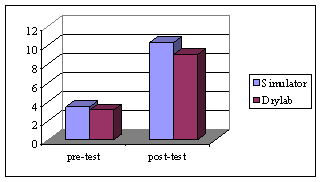
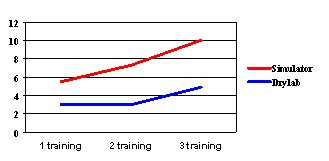
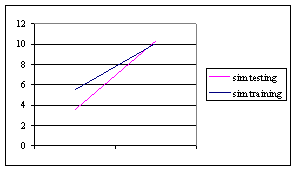
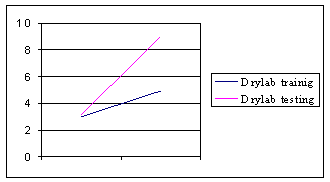
Picture 2, 3: Screenshot from SimLap-Zeus VR-simulator (SimSurgery, Oslo, Norway) The learning curve for the individual methods was expressed by the increase in the number of sutures placed and the decrease in time to complete three stitches in the test period after each training session. The subjective learning curve was expressed by the increased score in self evaluation. Statistics: Bivariate analysis for independent samples was used for comparison of normally distributed numerical variables. Normally distributed data were expressed as mean ± standard deviation (SD) and compared by means of the 2-sample t-test. Non-normally distributed data were expressed as median with 95% confidence intervals and compared by means of the Mann-Whitney U test. P< 0.05 was considered as statistically significant. 3. Results One of the students in the simulator group dropped out of the study. The groups did not differ with respect to the number of stitches placed during the pre-test. The actual learning curve In both groups there was a significant increase in the number of stitches placed in the pig model during 30 minutes from the pre test to the post test. In the group D the number of stitches increased from 3.2 +/- 1.3 before the training period to 9.0+/-3.6 after the training period (p<0.0001). In the group training with simulator, group S the number of stitches increased from 3.5 +/-1.2 to 10.3+/-3.0 (p<0.0001) (fig.1). The difference in the number of stitches during the post-test was not statistically significant. The actual learning curve shows the better progress in simulator group than in Drylab group. The difference between Δ’s for S-group and for D group was statistically significant (p<0,05) (Fig.2).
Fig. 1 Testing results
for both groups Fig.2 Learning
curve (by number of stiches) Ä
simulator – 4,52, Ä drylab – 1,92, p < 0,05 Fig.3 Learning
curve for Simulator group Fig.4 Learning
curve for DryLab group 4. Discussion Learning surgical technical skills can be divided into three phases [7]. In the cognitive phase the student gains understanding of the task, followed by the associative phase where the students learn to master the skills. During the autonomous phase the skills are mastered with little or no cognitive input. The students’ self evaluation of their understanding of the task was similar after the pre- and post-test. This implies that the improvement of results after training can be attributed to increased technical skills alone. The learning curve is steepest in the early part of training [8] so less time is needed to detect improvement of training in a novice group than in a more experienced group. Therefore we chose to use a group of students instead of more experienced surgeons. Learning is greatest during moderate stress [9]. The examination after each training session increases the stress level for the students and at the same time makes it possible to compare the learning curve assessed during the two types of training with the pre-/post test - assessed learning curve. Our results show that the learning curve for simulator examination was in close proximity to the actual learning curve. This finding implies that it is also possible to use simulators to evaluate surgical technique. Neal et.al. have found similar results [10] and that improved results on the simulator leads to better performance in the OR. Technical skills are only one of many attributes needed to become a good surgeon [11], but it should be obvious that in order to become a good surgeon, good technical skills are mandatory. At this stage of VR-simulation it is not possible to fully recreate the real life situation and train every aspect of technical skills. It is more feasible to determine what features are the most essential for the acquisition of technical skills at focusing on training these in using a VR-simulator [12]. The main finding of our study is that training robotically assisted anastomosis suturing using a VR-simulator without additional training equals training in dry lab, and that VR training can replace the standard way of training during the early part of training. At this point it is difficult to conclude which aspects of the technical skills are trained on the simulator that lead to overall improvement of technical skills. Anyway we show real advantage of VR-simulators which consist of low price, the same efficiency and possibility of simulating much more complicated procedures. Whether similar results also apply to more experienced surgeons, or if VR-training equals the standard way of training only in novice surgeons, require further studies. |
||||
|
Literature: |
||||